


You open your online investor portal. Your balance is down from yesterday. Your stomach tightens, even though nothing about your actual plan has changed. You close it, promise yourself you won't look again. And then you check it again the next day...
If that sounds familiar, you're not undisciplined. You're human. But there's a specific, calculable reason checking often makes investing feel worse than it should. And it has nothing to do with how your portfolio is actually performing.
Nassim Taleb ran the math on this in Fooled by Randomness, using a hypothetical investor earning a healthy 15% expected annual return.[1] Markets move on noise far more than they move on real, long-term performance. And the shorter the window you look through, the more that noise drowns out the signal. Here's what that does to your odds of seeing a gain, depending on how often you look:
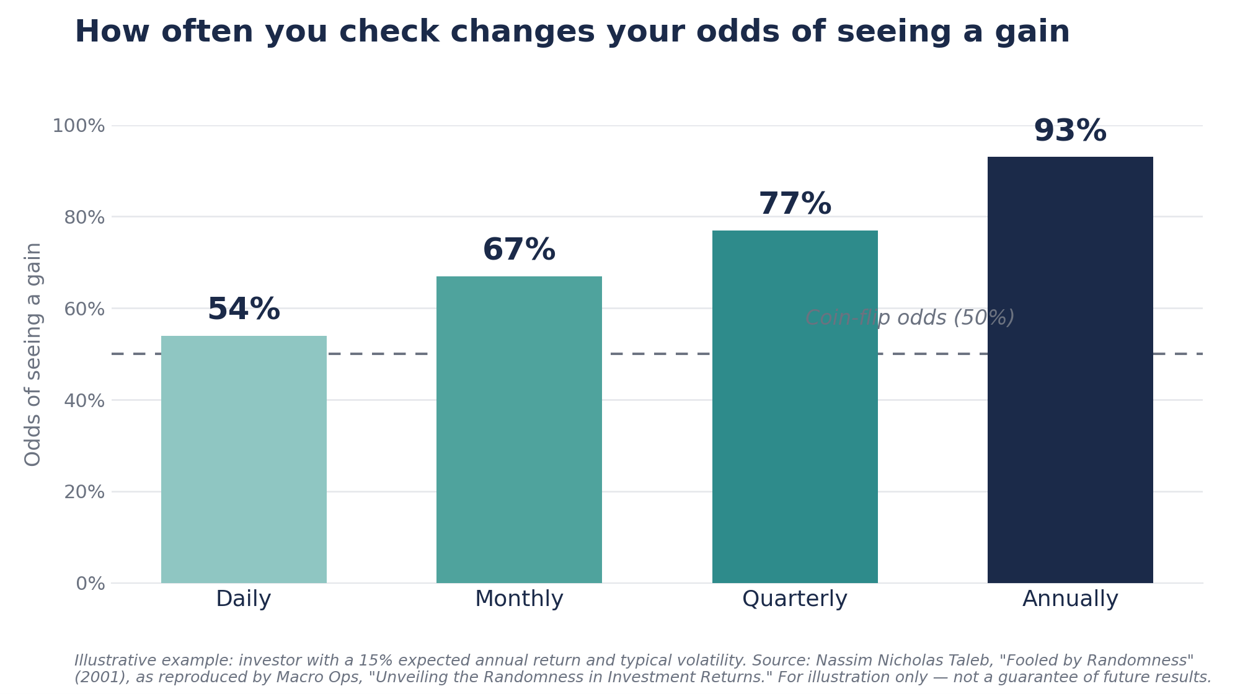
Check daily, and it's close to a coin flip whether you're pleased or upset. Check once a year, and the odds move firmly in your favour.
Behavioural economist Richard Thaler's research on loss aversion explains why this matters so much. A loss feels roughly twice as painful as an equivalent gain feels good.[2] So even with a 56/44 split of good days to bad, the emotional math doesn't balance. Although you’re likely to see up days a hair more than down. The down days weigh more, add up faster, and are far more likely to trigger a decision you'll regret: selling at the wrong moment, abandoning a sound plan, chasing whatever feels safer in that moment.
Checking your portfolio doesn't make it go up faster.
Looking at your portfolio more often won’t stop it from going down.
All it does is increase your exposure to the pain and the potential of making bad decisions when things don’t look all that good.
I’m not suggesting you look away entirely. That's not realistic, and a bit of monitoring is genuinely reassuring for some people. Instead, I'd like to challenge you to dial it back one notch.
If you check daily, try monthly. If you check monthly, try quarterly. If you're already at quarterly, see if you can stretch to your annual review.
Realistically, quarterly tends to be the sweet spot for most investors. It’s frequent enough to feel connected to your plan, infrequent enough that the odds are meaningfully in your favour (77% chance of seeing it up). Annually works even better on paper, and for many long-term investors, tying your check-ins to a proper annual review is more than enough.
This only works, of course, if the plan underneath is sound. If your asset allocation truly matches your tolerance and capacity for risk, and your advisor has accounted for your real short-term income needs, the day-to-day noise shouldn't require your attention at all. If your circumstances mean you genuinely need to look more often, like a real cash-flow need, or a life event, that's completely fair. The goal isn't a rigid rule. It's a about building habits that minimize unnecessary pain and that reduce your chances of making behavioural mistakes. Because staying the course is what could earn you the return your risk tolerance is entitled to.
Looking less isn't avoidance. It's discipline, backed by math. At Endeavour Wealth Management, our evidence-based approach starts with building a portfolio and a plan you can actually trust, so that closing the app isn't a leap of faith. It's simply the logical next step.
If you're not sure your portfolio is built to let you look less, that's exactly the conversation we'd like to have.
1] Nassim Nicholas Taleb, Fooled by Randomness (Texere, 2001) — probability table as reproduced by Macro Ops, "Unveiling the Randomness in Investment Returns."
• [2] Ben Carlson, "How Often Should You Check Your Portfolio?", A Wealth of Common Sense (August 2026).
• [3] PlanEasy, "The Larger Your Portfolio The Less Often You Should Check It."
• Richard H. Thaler, research on myopic loss aversion (as cited in source [2] above).
• Benjamin Felix / PWL Capital, "The Value of a Financial Advisor," Common Sense Investing / Rational Reminder.
This information has been prepared by Brandt Butt who is an Investment Advisor and Portfolio Manager for iA Private Wealth Inc. and does not necessarily reflect the opinion of iA Private Wealth. The information contained in this newsletter comes from sources we believe reliable, but we cannot guarantee its accuracy or reliability. The opinions expressed are based on an analysis and interpretation dating from the date of publication and are subject to change without notice. Furthermore, they do not constitute an offer or solicitation to buy or sell any of the securities mentioned. The information contained herein may not apply to all types of investors. The Investment Advisor and Portfolio Manager can open accounts only in the provinces in which they are registered.
iA Private Wealth Inc. is a member of the Canadian Investor Protection Fund and the Canadian Investment Regulatory Organization. iA Private Wealth is a trademark and a business name under which iA Private Wealth Inc. operates.
Dolly Parton has spent a lifetime building a legacy through her music, her generosity and the people she has touched along the way. Recent headlines..
September 28, 2026
I did something this year that I feel really good about for my girls’ future. We bought Rachel and Leah critical illness insurance.
September 21, 2026
In July 2025, the Bank of Canada estimated that approximately 60% of all outstanding Canadian mortgages would renew in 2025 or 2026. That means.
August 17, 2026
Download your free guide to financial freedom.
Download your free guide to learn how you can protect your retirement savings with a Personal Pension Plan.
Download your free guide to help ensure you don’t run out of money.
Download your free guide to learn how to ensure your portfolio and plan stay on track.


